Datei:PID Compensation Animated.gif
Zur Navigation springen
Zur Suche springen
Es ist keine höhere Auflösung vorhanden.
PID_Compensation_Animated.gif (400 × 300 Pixel, Dateigröße: 401 KB, MIME-Typ: image/gif, Endlosschleife, 250 Bilder, 20 s)
Hinweis: Aufgrund technischer Beschränkungen werden Vorschaubilder hochauflösender GIF-Dateien wie dieser nicht animiert.
Beschreibung
| Beschreibung |
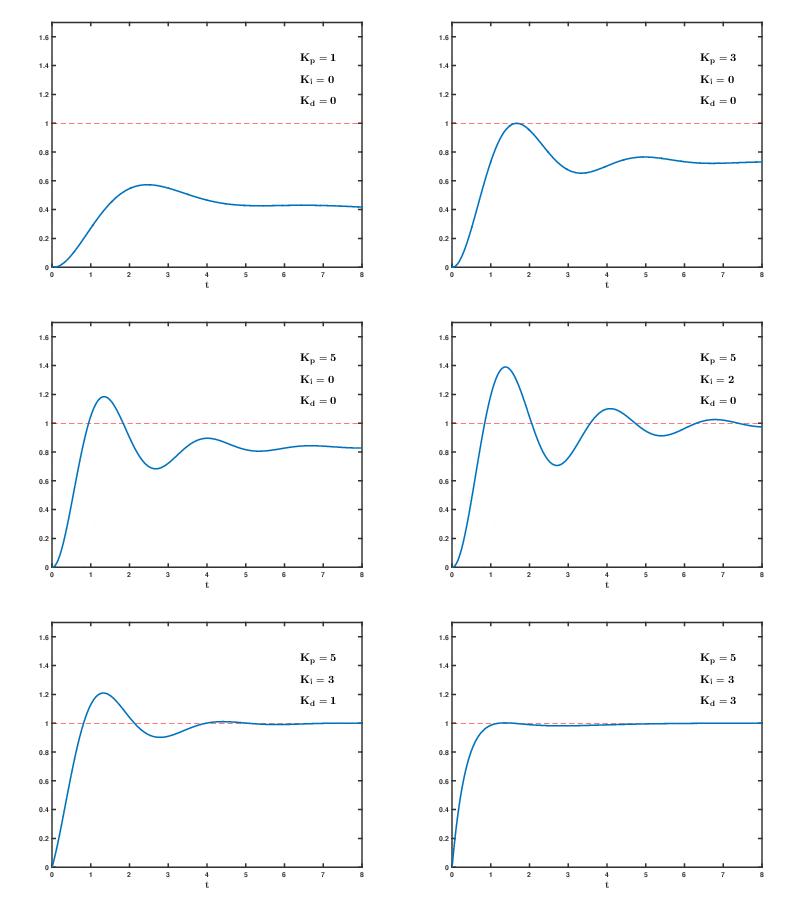
English: In a unity feedback configuration, an ideal PID compensator is used to enhance the step response of a system with the transfer function
The PID controller has the standard form Kp+Ki/s+Kds. Therefore, the closed loop transfer function of the whole system becomes
As the proportional, integral and derivative terms of the PID compensator are increased, the evolution of the step response, from the initial uncompensated response (corresponding to PID coefficents Kp=1, Ki=0, Kd=0) to the final desired response is depicted. The following effects of PID compensation can be readily observed:
|
| Datum | |
| Quelle | Eigenes Werk |
| Urheber | Physicsch |




Lizenz
Ich, der Urheber dieses Werkes, veröffentliche es unter der folgenden Lizenz:
 
|
Diese Datei wird unter der Creative-Commons-Lizenz CC0 1.0 Verzicht auf das Copyright zur Verfügung gestellt. |
| Die Person, die das Werk mit diesem Dokument verbunden hat, übergibt dieses weltweit der Gemeinfreiheit, indem sie alle Urheberrechte und damit verbundenen weiteren Rechte – im Rahmen der jeweils geltenden gesetzlichen Bestimmungen – aufgibt. Das Werk kann – selbst für kommerzielle Zwecke – kopiert, modifiziert und weiterverteilt werden, ohne hierfür um Erlaubnis bitten zu müssen.
|
Dateiversionen
Klicke auf einen Zeitpunkt, um diese Version zu laden.
| Version vom | Vorschaubild | Maße | Benutzer | Kommentar | |
|---|---|---|---|---|---|
| aktuell | 01:35, 29. Mai 2015 | | 400 × 300 (401 KB) | wikimediacommons>Physicsch | Made the axes and numbers bold for better visiliblity. |
Dateiverwendung
Die folgende Seite verwendet diese Datei:
