Datei:Gravitationell-lins-4.jpg
Zur Navigation springen
Zur Suche springen

Größe dieser Vorschau: 577 × 599 Pixel. Weitere Auflösungen: 231 × 240 Pixel | 462 × 480 Pixel | 740 × 768 Pixel | 986 × 1.024 Pixel | 1.973 × 2.048 Pixel | 3.853 × 4.000 Pixel.



Originaldatei (3.853 × 4.000 Pixel, Dateigröße: 5,76 MB, MIME-Typ: image/jpeg)

Beschreibung
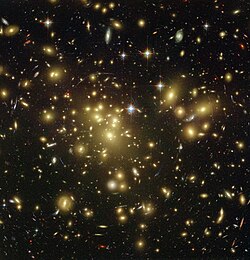
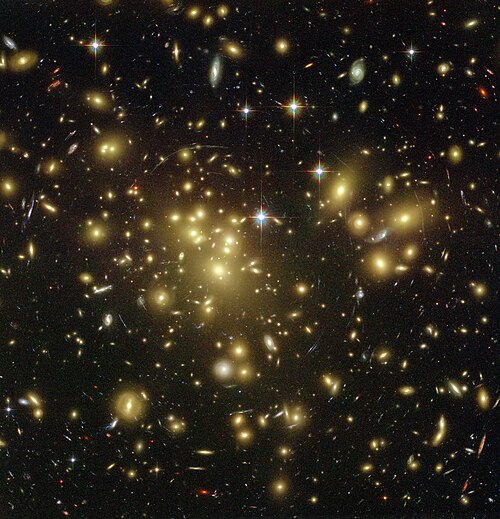
| Beschreibung | A massive cluster of yellowish galaxies, seemingly caught in a red and blue spider web of eerily distorted background galaxies, makes for a spellbinding picture from the new Advanced Camera for Surveys aboard NASA's Hubble Space Telescope. To make this unprecedented image of the cosmos, Hubble peered straight through the center of one of the most massive galaxy clusters known, called Abell 1689. The gravity of the cluster's trillion stars — plus dark matter — acts as a 2-million-light-year-wide lens in space. This gravitational lens bends and magnifies the light of the galaxies located far behind it. Some of the faintest objects in the picture are probably over 13 billion light-years away (redshift value 6). |
| Datum | published on 2003-01-07 (taken in 2002-06) |
| Quelle | http://hubblesite.org/newscenter/newsdesk/archive/releases/2003/01/image/a |
| Urheber | NASA, N. Benitez (JHU), T. Broadhurst (Racah Institute of Physics/The Hebrew University), H. Ford (JHU), M. Clampin (STScI),G. Hartig (STScI), G. Illingworth (UCO/Lick Observatory), the ACS Science Team and ESA |
| Andere Versionen |
 |
Lizenz

|
Diese Datei ist gemeinfrei, da sie von NASA und ESA erstellt wurde. Das Hubble-Material der NASA (und das Hubble-Material der ESA vor 2009) ist urheberrechtsfrei und kann ohne Gebühr als gemeinfrei verwendet werden, sofern nur die NASA, das STScI und/oder die ESA als Quelle des Materials angegeben werden. Diese Lizenz gilt nicht, wenn ESA-Material, das nach 2008 erstellt wurde, oder Quellmaterial anderer Organisationen verwendet wird.
Das Material wurde für die NASA vom Space Telescope Science Institute unter dem Vertrag NAS5-26555 oder für die ESA vom Hubble European Space Agency Information Centre erstellt. Urheberrechtserklärung auf hubblesite.org oder 2008 Urheberrechtserklärung auf spacetelescope.org. Für Material, das von der European Space Agency auf der Website spacetelescope.org seit 2009 erstellt wurde, verwende die Lizenzvorlage {{ESA-Hubble}}. |
| Bildnotizen | Diese Datei ist annotiert: Betrachte diese auf Commons. |
Dateiversionen
Klicke auf einen Zeitpunkt, um diese Version zu laden.
| Version vom | Vorschaubild | Maße | Benutzer | Kommentar | |
|---|---|---|---|---|---|
| aktuell | 18:01, 26. Apr. 2019 | | 3.853 × 4.000 (5,76 MB) | wikimediacommons>FriedrichKieferer | Better quality. |
Dateiverwendung
Die folgende Seite verwendet diese Datei:
